Caching
Winslow has two cache scopes, declared the same way and read the same way:
| Cache | Scope | Constructed with |
|---|---|---|
GlobalCache |
one process, shared by the workflows | the orchestrator config |
WorkflowCache |
one workflow session | the workflow config |
For data that lives and dies with one task, stay with the task-local tools: a plain
functools.cached_property for instance memoization, and
transient_property for a value that one execution
pass of a batch shares between check() and run(). Reach for a cache class when tasks, hooks or
workflows share the data.
Declare a cache
A cache class lives in a cache.py file, or in any module of a cache/ package - a hard rule, not
a convention: the framework imports only these locations. A GlobalCache
is collected from the whole project tree; a WorkflowCache from the directory of its workflow.
Share loader helpers on a base class with Meta.abstract, the same way as for a workflow or a
task (see Share a base class). One file can declare both
scopes:
class Forecast(WorkflowCache):
    """Session-scope data: a new session builds a fresh instance. cities feeds
    get_parameters, conditions expires after its ttl and recomputes."""

    @entry(eager=True)
    def cities(self):
        self.logger.info("forecast: listing the cities (1s)…")
        time.sleep(1)  # stands in for a slow catalog call
        return ("oslo", "bergen", "tromso")

    @entry(eager=True, depends_on="cities")
    def city_index(self):
        return {city: index for index, city in enumerate(self.cities)}

    @entry(ttl=300)
    def conditions(self):
        self.logger.info("forecast: sampling the conditions (1s)…")
        time.sleep(1)  # stands in for a slow sensor sweep
        return {"oslo": -3, "bergen": 4, "tromso": -8}


class Stations(GlobalCache):
    """Process-scope reference data, shared by every workflow."""

    @entry(eager=True)
    def codes(self):
        self.logger.info("stations: loading the station registry (2s)…")
        time.sleep(2)  # stands in for a slow reference-data query
        return {"oslo": "ENOS", "bergen": "ENBG", "tromso": "ENTR"}
Declare each field with @entry. The bare form is lazy and behaves like cached_property plus a
lock: the field computes on first access, once per instance, and two threads that hit it cold
compute it once. The called form takes four options:
eager=Truepopulates the field at workflow initialization -citiesandcodesabove (see Prepopulate a cache).depends_on="cities"(a name or a tuple) declares that this field is computed from another. It gates validation and the invalidation cascade.ttl=300expires the value 300 seconds after its computation; the next access recomputes.display_style=DisplayStyle.TREEselects how the TUI renders the value (see User interface).
Prepopulate a cache
Entries annotated with eager=True are pre-populated during the workflow initialization, in
parallel. An entry with dependencies (depends_on=...) waits for its dependencies to be
pre-populated first:
class Forecast(WorkflowCache):
    @entry(eager=True)
    def cities(self):
        ...

    @entry(eager=True, depends_on="cities")
    def city_index(self):
        return {city: index for index, city in enumerate(self.cities)}
Disable the parallel pre-population with the --disable-concurrency command-line argument.
Read a cache
Tasks, workflows and graphs carry both containers; each cache is an attribute on its container,
under the cache name. The name is generated from the class name, snake-cased - or taken from a
name override, which must match [a-z_][a-z0-9_]*:
class SensorReadings(WorkflowCache):
    @entry
    def levels(self): ...


class Calibrate(Task):
    def run(self):
        # the snake-cased class name is the attribute:
        readings = self.workflow_cache.sensor_readings.levels
        ...
class SensorReadings(WorkflowCache):
    name = "sensors"

    @entry
    def levels(self): ...


class Calibrate(Task):
    def run(self):
        # the override is the attribute:
        readings = self.workflow_cache.sensors.levels
        ...
self.global_cache serves the global scope the same way:
Outside an instance of a workflow, a graph or a task, the caches are accessed through two module
functions: get_global_cache() and get_workflow_cache(). A classmethod hook is the common case -
it runs before a task instance exists:
from winslow.cache import get_global_cache, get_workflow_cache

@classmethod
def get_parameters(cls, workflow_config):
    codes = get_global_cache().stations.codes
    return [{"city": c} for c in get_workflow_cache().forecast.cities if c in codes]
Which workflow does get_workflow_cache() return?
The one being initialized at that moment - each workflow's hooks see their own caches, even
with several workflows live. Everywhere else, use self.workflow_cache instead.
Cache invalidation
A dependent entry declares its upstream with depends_on - the declarations form the chain that
an invalidation follows:
class Forecast(WorkflowCache):
    @entry
    def cities(self): ...

    @entry(depends_on="cities")
    def city_index(self): ...

    @entry(depends_on="city_index")
    def alerts(self): ...

    @entry(ttl=300)
    def conditions(self): ...
A loader reads its declared upstream entries. Invalidation belongs to the callers of the cache: a task, a hook or the Caches tab.
invalidate takes one or more entry names, and drops each with its declared dependents,
transitively. invalidate_all drops everything. A dropped entry recomputes on its next access -
an eager field too:
cache = self.workflow_cache.forecast

cache.invalidate("cities")               # drops cities, city_index and alerts; conditions stays
cache.invalidate("city_index")           # drops city_index and alerts; cities stays
cache.invalidate("alerts", "conditions")  # drops both, in one call
cache.invalidate_all()                   # drops every entry of the instance
Tune the ttl per entry, to the pace of that entry's data. Reach for ttl
when time makes a value stale; reach for invalidate when an event makes it wrong.
Clear the cache
Start a run cold with the --clear-cache command-line argument: every entry of both scopes is
invalidated at workflow initialization, before the eager population, and the recomputed values are
written back to every persistent tier.
In the TUI and the web UI, the same option is on the workflow start form: select it before starting the session.
User interface
When the project declares at least one cache, the workflow screen gains a Caches tab, next to the
task list. The tab shows one card per cache, across both scopes. Each card lists the declared
entries, and each row shows the live entry state - cold, warm, stale, computing,
errored - with a preview of the value:
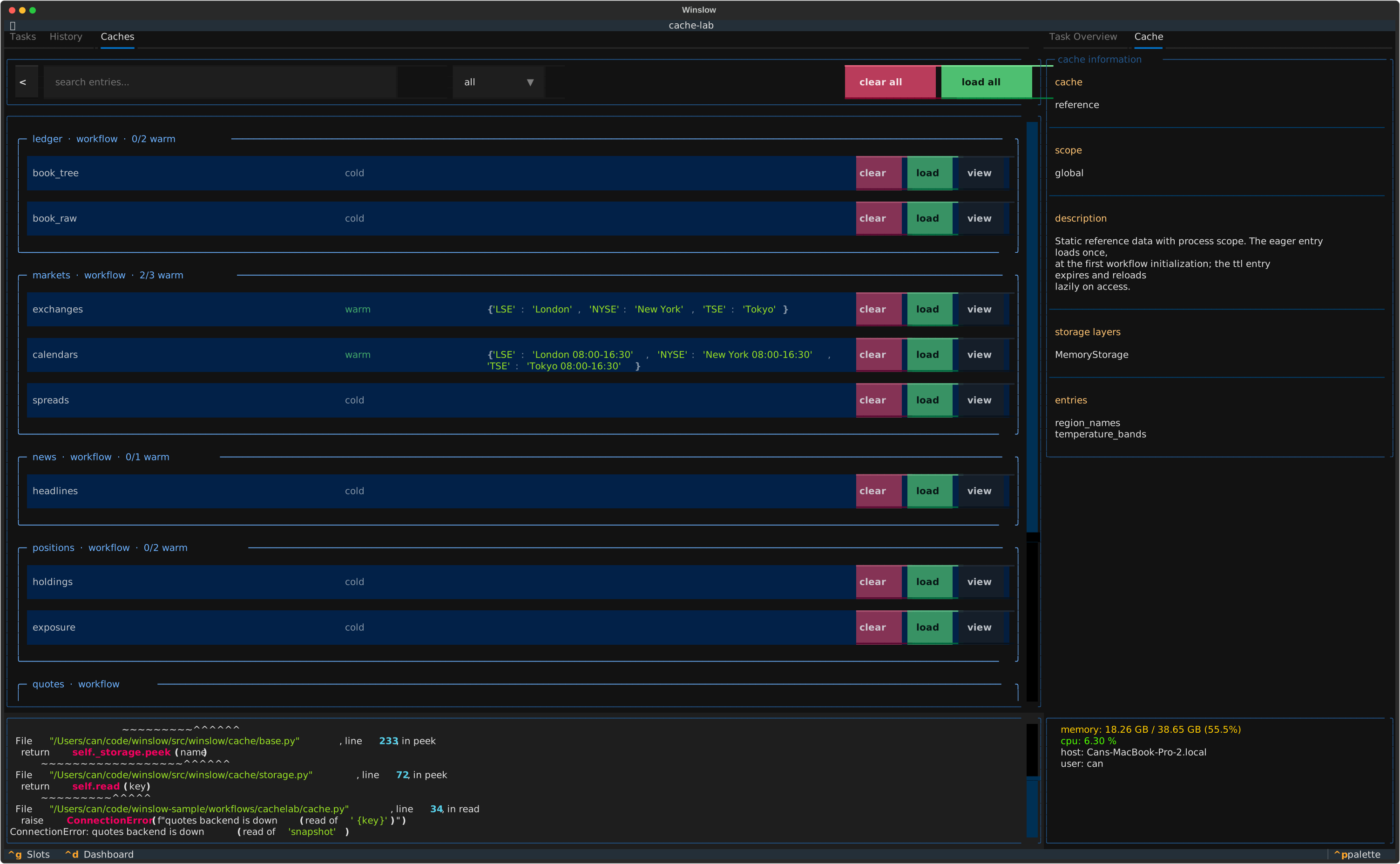
Every row carries three actions:
- clear invalidates the entry, together with its declared dependents (see Cache invalidation).
- load runs the loader now. Use it after a clear to reload a value without waiting for the next read.
- view opens the full value in a modal, rendered per the entry's
display_style.
display_style is an @entry option with three forms. RAW, the default, pretty-prints the
value. TREE renders a container as a tree that expands level by level, for a large value that a
flat print would flood. A callable is a custom renderer: it takes the value and returns the string
to show:
from winslow.cache import DisplayStyle, WorkflowCache, entry


class Forecast(WorkflowCache):
    @entry  # RAW is the default
    def conditions(self): ...

    @entry(display_style=DisplayStyle.TREE)
    def alerts(self): ...

    @entry(display_style=lambda frame: frame.to_string())
    def readings(self): ...
The header narrows the pane: search the entries by name, or select one scope. The bulk actions
follow the narrowed view - clear all invalidates every cache with a visible entry, and
load all loads every visible entry, in parallel like the
eager population. Select a card to see the cache details in the overview
pane: its scope, its storage layers and its entries. For each entry with depends_on, the
overview lists one row per upstream entry with the live state of that upstream, so a stale
dependency shows next to the entry it feeds.
Cache storage
Values live behind a storage backend, declared on the cache class with storage_class. The
default is MemoryStorage: values stay in the process, and a fresh session starts cold.
class Forecast(WorkflowCache):
    storage_class = MemoryStorage  # the default

    @entry(ttl=300)
    def conditions(self): ...
Declare JsonFileStorage on a cache whose values should survive the process. A new process
starts warm from the files. Each entry lives at
<cache root>/<namespace>/<cache-name>/<entry>.json: open the file to inspect a value, delete
it to drop one.
Set the cache root with the CACHE_DIR setting. The default is .winslow/{env}/cache, relative to
the working directory, and {env} resolves to ENV, so each environment keeps its own values. Set
an absolute path so every entry point of the project shares one cache:
For JsonFileStorage, the values must fit the JSON types
Store values that JSON can represent. Some types are converted: a tuple comes back as a list.
A non-string dict key is converted to a string: {1: "a"} becomes {"1": "a"}.
class Stations(GlobalCache):
    storage_class = JsonFileStorage  # one JSON file per entry

    @entry
    def codes(self): ...
Compose backends into tiers with compose; declaration order is read order. A read serves the
first hit and promotes it upward, a write runs bottom-up - the memory tier answers repeat reads,
the file tier keeps the values across restarts:
class Stations(GlobalCache):
    storage_class = compose(MemoryStorage, JsonFileStorage)  # memory over file

    @entry
    def codes(self): ...
The <namespace> path segment is global for a GlobalCache. A WorkflowCache gets one
directory per run identity: declare a config option with identifier=True to put it in the
identity:
class Etl(Workflow):
    region = ConfigOption(identifier=True, help_text="The market region of this run.")
$ winslow run --workflow etl --region eu   # .winslow/local/cache/workflows/etl-eu-3f9a1c2b/
$ winslow run --workflow etl --region us   # .winslow/local/cache/workflows/etl-us-9d01f7a2/
How is the directory name generated?
From the workflow name and its identifier values. The name and the scalar values form the
readable prefix (etl-eu), and a short digest of the full identity is appended (3f9a1c2b).
A list or other structured identifier counts in the digest, even though it stays out of the
prefix. Same name and identifiers - same directory, on every run.
Custom storage backends
Subclass BaseStorage to build a backend, and override the three methods. Return the MISSING
sentinel for a cold key, and return the stored record from write: the cache serves what the
write returns. A StorageRecord carries the value, written_at, and written_by, the user whose
load wrote it. A backend that stores the writer returns it on read, and a backend that stores the
value and the time alone stays valid: written_by defaults to None.
from winslow.cache import MISSING, BaseStorage, StorageRecord


class RedisStorage(BaseStorage):
    def read(self, key):
        ...  # return a StorageRecord, or MISSING for a cold key

    def write(self, key, record):
        ...  # store the record, return the stored record

    def delete(self, key): ...
Declare read_only = True on a backend to make it a pure source inside a
composed storage: the writable tiers take the writes and the deletes, and after
an invalidation the next access re-reads through the source.
A complete example
The weather example puts the pieces together: the caches from
Declare a cache - here in full, with the file tier that persists the station
registry - next to the workflow that reads them. The loaders sleep to stand in for expensive
calls, so the cache effects are visible in the runtime.
import time

from winslow.cache import (
    GlobalCache,
    JsonFileStorage,
    MemoryStorage,
    WorkflowCache,
    compose,
    entry,
)


class Forecast(WorkflowCache):
    """Session-scope data: a new session builds a fresh instance. cities feeds
    get_parameters, conditions expires after its ttl and recomputes."""

    @entry(eager=True)
    def cities(self):
        self.logger.info("forecast: listing the cities (1s)…")
        time.sleep(1)  # stands in for a slow catalog call
        return ("oslo", "bergen", "tromso")

    @entry(eager=True, depends_on="cities")
    def city_index(self):
        return {city: index for index, city in enumerate(self.cities)}

    @entry(ttl=300)
    def conditions(self):
        self.logger.info("forecast: sampling the conditions (1s)…")
        time.sleep(1)  # stands in for a slow sensor sweep
        return {"oslo": -3, "bergen": 4, "tromso": -8}


class Stations(GlobalCache):
    """Process-scope reference data, shared by every workflow."""

    @entry(eager=True)
    def codes(self):
        self.logger.info("stations: loading the station registry (2s)…")
        time.sleep(2)  # stands in for a slow reference-data query
        return {"oslo": "ENOS", "bergen": "ENBG", "tromso": "ENTR"}

    # The file tier keeps the registry warm: a second run reads
    # .winslow/local/cache/ and skips the slow load.
    storage_class = compose(MemoryStorage, JsonFileStorage)
from pathlib import Path

from winslow import Parameter, Task, Workflow
from winslow.cache import get_workflow_cache

STATE = Path("state")


class Weather(Workflow):
    """Shows both cache scopes: the forecast workflow cache feeds
    get_parameters and the tasks, the stations global cache serves shared
    reference data (see cache.py)."""


class ReportCity(Task):
    """One report per city. The city list comes from the workflow cache before
    a task instance exists, so it is read through the module function."""

    city = Parameter()

    @classmethod
    def get_parameters(cls, workflow_config):
        return [{"city": c} for c in get_workflow_cache().forecast.cities]

    @property
    def report(self):
        return STATE / f"{self.city}.txt"

    def run(self):
        station = self.global_cache.stations.codes[self.city]
        temperature = self.workflow_cache.forecast.conditions[self.city]
        STATE.mkdir(exist_ok=True)
        self.report.write_text(f"{station}: {temperature}c\n")

    def check(self):
        return self.report.exists()


class Summarize(Task):
    """Aggregates the reports after every city wrote one."""

    dependencies = ReportCity

    @property
    def summary(self):
        return STATE / "summary.txt"

    def run(self):
        index = self.workflow_cache.forecast.city_index
        cities = sorted(index, key=index.get)
        reports = (STATE / f"{city}.txt" for city in cities)
        self.summary.write_text("".join(p.read_text() for p in reports))

    def check(self):
        return self.summary.exists()
Run it twice from examples/weather/, deleting the reports in between - the tasks are idempotent,
so a second run over an existing state/ reports COMPLETED_PREVIOUSLY instead of running:
$ winslow run --mode headless --workflow weather   # ~4s: every loader runs
$ rm -rf state                                     # delete the reports so the tasks run again
$ winslow run --mode headless --workflow weather   # ~2s: stations reads its file
Both runs write state/summary.txt. The second one skips the 2s station registry: the global
cache warm-starts from .winslow/local/cache/global/stations/codes.json. The forecast loaders run
again, because a new session builds fresh WorkflowCache instances.